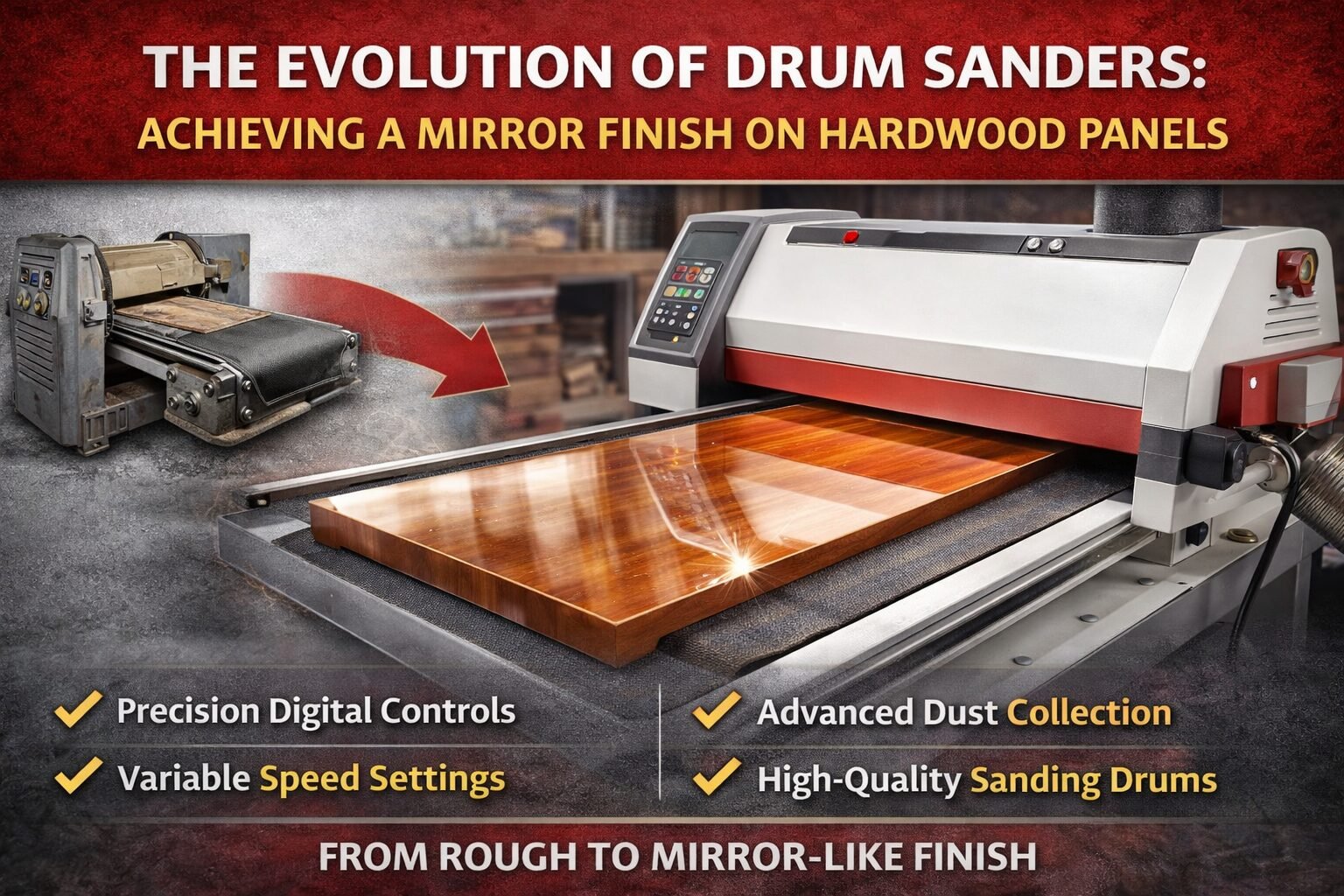
The Evolution of Drum Sanders: Achieving a Mirror Finish on Hardwood Panels
Modern drum sanders have transformed from aggressive material-removal machines into precision finishing systems capable of delivering flawless mirror-finish hardwood surfaces.
In the competitive world of premium furniture and architectural paneling, the finish quality defines the product. A flawless mirror-like surface is no longer achieved only through days of manual sanding.
Today, modern Drum Sanders have evolved into highly sophisticated finishing systems capable of producing ultra-smooth hardwood panels with incredible consistency and speed.
Dimensional Sanding vs. Finish Sanding
Traditional drum sanders were designed primarily for aggressive stock removal and thickness calibration. While powerful, they often left deep scratch marks and surface oscillations that required extensive manual finishing afterward.
The shift toward precision finish sanding happened because of two major technological advancements:
Precision Balanced Arbors
Modern dynamically balanced spindles eliminate vibration and prevent ripple marks on hardwood surfaces.
Variable Speed Feed
Precise feed-speed control allows accurate dwell time management between abrasive and wood surface.
The Mechanics of Precision
Achieving a true mirror finish requires a carefully controlled three-stage sanding workflow.
Humidity and Material: The Unseen Finisher
Achieving a mirror finish on hardwoods such as Teak or Rosewood becomes especially challenging in humid environments like Gujarat because wood constantly reacts to atmospheric moisture.
Modern Smart Sanding Solutions
Digital Thickness Readouts
Enable highly accurate panel thickness monitoring.
Laser Micrometer Integration
Measures panel thickness instantly and adjusts machine settings automatically.
0.1mm Automatic Corrections
Modern Sundaram systems can dynamically adjust sanding precision during production.


 Mar 30, 2026