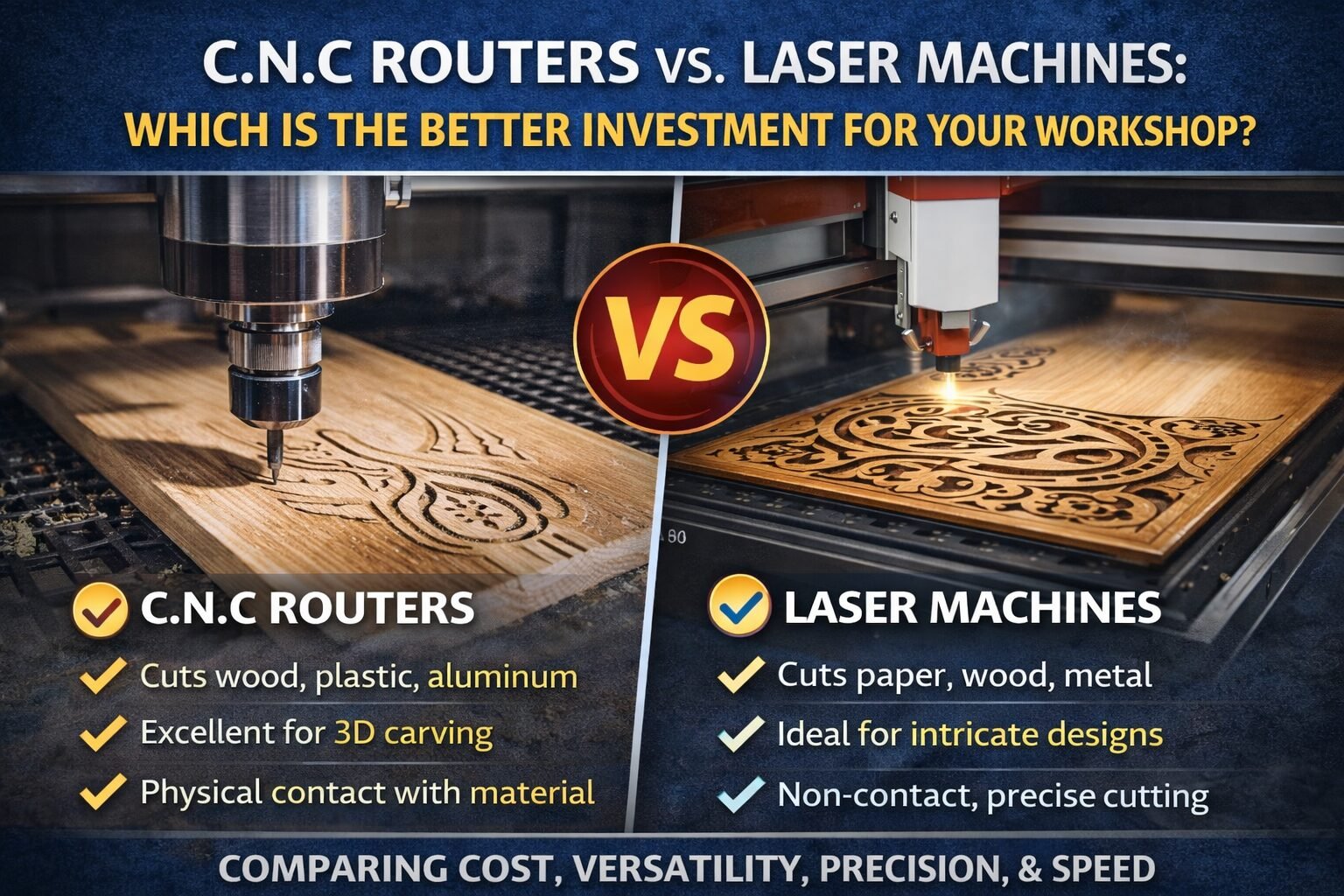
As we move through 2026, the “CNC vs. Laser” debate has shifted. It’s no longer about which machine is better in isolation, but which one fits your production goals and material thickness.
At Sundaram Corporation, manufacturers in Ahmedabad and across India are using both CNC routers and laser machines for different market segments.
The Fundamental Difference
CNC Routers: Use a high-speed spinning bit to physically cut through material. It is a subtractive mechanical process.
Laser Machines: Use a concentrated beam of light to vaporize or burn through material. It is a non-contact thermal process.
Comparison at a Glance (2026 Standards)
| Feature | CNC Router | CO2 Laser Machine |
|---|---|---|
| Max Thickness | Up to 50mm+ per pass | Typically 6mm–12mm |
| 3D Capability | True 3D carving, V-grooves, pockets | 2D engraving and cutting |
| Edge Finish | Natural wood finish | Dark / charred edge |
| Intricacy | Limited by bit diameter | Micro-precision detail |
| Materials | Wood, aluminium, plastics, composites | Wood, acrylic, leather, fabric |
When to Choose a CNC Router
- Furniture & Cabinetry: Best for full sheet cutting, modular kitchens, and wardrobes.
- Heavy Joinery: Suitable for mortise, tenon, dovetail, and deep pocketing.
- 3D Carving: Ideal for ornate doors, panels, and decorative mouldings.
- Versatility: One machine can cut, engrave, drill, and shape thick materials.
When to Choose a Laser Machine
- Intricate Engraving: Perfect for logos, photos, and detailed patterns.
- Thin Materials: Best for models, cake toppers, and inlay work.
- Acrylic Cutting: Gives a clean flame-polished edge.
- Quiet Operation: Useful for small studios and urban workshops.
The Hybrid Strategy for 2026
In many high-output Indian factories, CNC routers and laser machines work together. The Sundaram CNC Router handles heavy-duty sizing and 3D shaping, while the CO2 Laser is used for branding, decorative filigree, and intricate fretwork.

 Mar 24, 2026